Showing posts with label dwarf varieties. Show all posts

Thursday, July 7, 2016

Traveling, Blueberries & Texas Sunshine

So you'd think that after moving just about once a year for the last couple years, I'd learn my lesson and just pick a spot to settle down. Yeah...about that.

It all started about 1.5 years ago when I decided I needed to start looking for a new job (preferably in the medical field or related to it)--one I could spend a career doing. More complex applications than I wanted to count later, I finally got a job offer late last year. Catch was that I had to relocate... Again. I thought about it, but decided to take the job anyway and haven't regretted it yet.

Minerva is helping me pack the Uhaul to move.
So this past month, I got a trailer hitch for my car and installed it with a large amount of help from one of my rescue squad coworkers (for whose help I'm incredibly grateful!). I packed as much of my things as I could fit in a 4'x 8' Uhaul trailer, hitched it up, stuffed my cat into her carrier, and headed down the road. I didn't have much room left for my potted garden.

Minerva all buckled in and ready to travel.
But I managed to find space for my patio blueberry bush and one shamrock. Minerva promptly started trimming the leaves off the shamrock (of course). 

This is Minerva getting to stretch her legs at a rest stop. She obviously was more interested in the outside world than the important business of the litter box.
We saw some truly gorgeous scenery along the way and met up with friends for dinner in Nashville one evening. 

View of the western Smoky Mountains in North Carolina. So pretty, right?
Minerva has to go live with my brother for awhile, since my new housemate is allergic. So we stopped at his place to drop her off and I finally arrived at my new place late that night. She seems to be getting along well with my brother. Her new discovery is the ceiling fan which she hasn't figured out how to swat... Yet.

I love her pose and the look on her face! "It's... It... It MOVES!!!!"
I managed to get in a few shifts at the rescue squad and fire company during the chaos of getting ready to move. 


I didn't get as many calls as I wanted, but that was probably a good thing. The only noteworthy one happened when I was riding backwards on the engine and it was a mess. It was dispatched as a motorcycle vs. car wreck. The first-arriving unit didn't know where they were, so everyone was driving around trying to find the location. We finally arrived to find that a motorcyclist had run into the center of the trunk of a stopped car, throwing the rider through the air to land about 20' in front of the stopped car. The rider managed to get up and make it to the shoulder of the road. Upon arrival, I went to take over patient care, since I was the first medic on scene. Two minutes later, two more medics materialized and assumed patient care without so much as asking who was in charge or what was going on. "Karma" has a way of exacting it's own revenge though. The usurping medics initially made the wrong transport decision, then omitted a key piece of information during their report to medical control and got a verbal (and public) put down over the airwaves from the doc. But "karma" wasn't done yet. Their unit broke down enroute to the trauma center. Yep.

So, Lesson #1-- Know where you are. Keep aware of your surroundings so you can accurately describe your location so help can get to you. It does no good whatsoever if you're screaming for a medic over the radio but the medic has no idea where to find you!

Lesson #2--Don't be rude! When you roll up to a situation (regardless of whether it's fire/EMS related), have the courtesy to find out who is in charge and what is going on. Professionalism is expected of you regardless of whether you're working in your chosen career field or volunteering. Don't act the way the second arriving medics did on my call. I was there, handling the situation just fine, and they brushed me aside without even asking me who I was or what I had. 

Since there's a distinct possibility one of the calls I ran that week involved an impaired driver, let me reiterate another lesson you should already know. **climbs on soapbox**
Lesson #3--Don't drive if you're impaired--exhausted or even mildly intoxicated, it doesn't matter. This past Monday was July 4th, and a lot of people like to kick back, have some fun and drink alcohol of some sort. Or are traveling long distances after a long busy day of celebration. If you're impaired, don't drive. If you're tired, pull over and take a nap--because it's not worth falling asleep at the wheel. Yeah... Which means that your friendly neighborhood medic has mixed feelings about your trip home or wherever you're headed. You could injure or kill an innocent person or yourself. Bad. You could also provide said medic with an exciting new story and opportunity to practice rare skills. I'll be shaking my head at your idiocy and probably your antics. Makes for fantastic stories. But I'd rather not have to scrape anyone off the pavement. So stay safe, take a nap if you need it, stay off the roads, and yeah, stay out of the Emergency Room. **climbs off soapbox and walks into the garden**

That lonely blueberry bush I dragged with me all the way from Virginia has done very well, all things considered. I got it at a nursery sale last year half dead. It survived the winter, and has about three times the amount of berries on it this year as it did last year. And it did all this with me neglecting it all year. I think if I'd pruned and fertilized it, it would have produced more. 

Considering how many miles this blueberry bush has traveled, it looks really good!

I think it has about 6-7 berries left on it because I've been picking them as they get ripe. They were good! 

Blueberry bushes can manage very well in containers on a patio--they do best in bigger containers. They like acidic (pH 4.5-5.5), well-draining soil, and they need lots of water and lots of sun. One article I read was saying that you should regularly monitor the pH of soil in the pot and give a little bit of acidic fertilizer as needed to maintain a low pH and happy plant. They should be heavily pruned each year. Letting the bush grow without pruning tends to result in it overproducing smaller berries. When I was researching how to care for my blueberry bush, most of the instructions I read said to be careful to not over fertilize and use an acidic fertilizer such as one for rhododendrons. 

As far as pruning goes, the consensus seems to be that you need to prune them in the winter or early spring when they first start to bud. First, take out any dead wood. Second, take out any light-colored, less healthy branches in the center all the way down at their base. Third, trim off branches with little to no fruit buds or long with few leaves or branches before the ends. The following article I found was particularly helpful:

While I'm excited about my new job and new state and all, it's kind of sad having to start from scratch on my garden again.  But, it means I can get creative, and work on quality rather than quantity. Speaking of which, I have a new planter to plan right about now.

Sunday, May 1, 2016

Patio Herb Gardening

I know it's been awhile since I posted, but I got a new job a few months back. Consequently, I'm preparing to move again and I've been in training, so I haven't had much time to write. I am happy to report that I have managed to keep a few plants alive despite being extremely busy studying for exams.

These past couple months, the anniversaries of a handful of difficult calls came and went. I've found that memories seem to pick their own time and place to resurface. And it is sometimes difficult to put them to rest. Each time they are brought out of the proverbial closet and worked through, it gets easier to handle. I like to think this process is comparable pruning. Plants are much healthier when trimmed and pruned regularly. And yeah, I prefer to do something constructive while working through things...like gardening. Particularly, working with herbs because they smell so good. Aromatherapy anyone?

One of my favorite planters is my herb box. I started with a light gray plastic window box planter about 5 years ago. The plant arrangement has remained more or less the same since then. I managed to fit four different varieties of herbs comfortably in the box. It isn't my only pot of herbs though.

Gray window-box of herbs in 2012. From L-R:
Lemon Thyme, Rosemary, Parsley and Oregano
Since some of these plants are perennials and some are annuals, I've had to replant the ones that die each year. For home cooking, here's a rundown on six of the most useful herbs to grow.

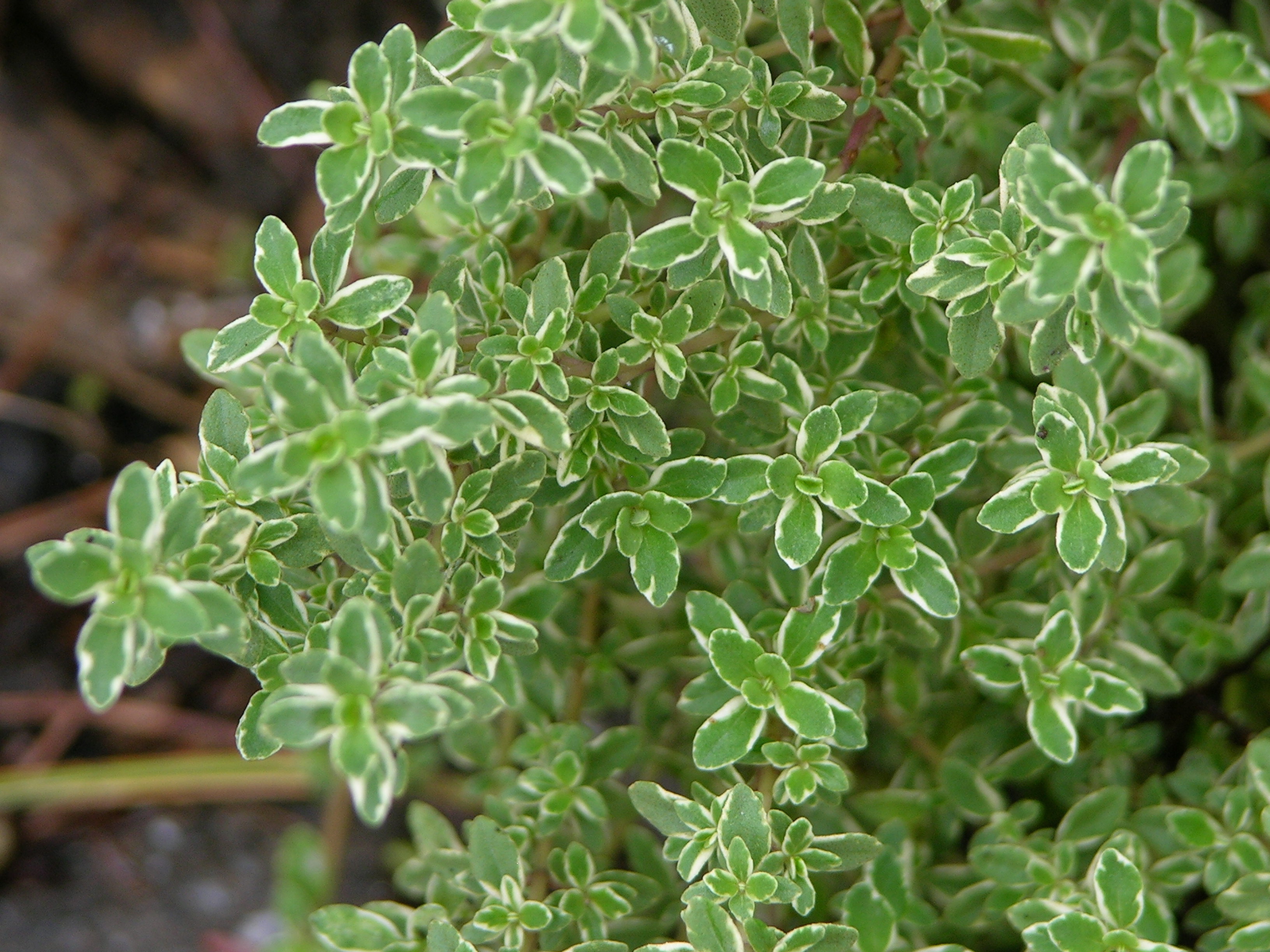
Thyme: Thyme is an annual (meaning it has a seasonal life cycle and dies after it's flowered and produced seeds), and comes in many varieties. Some of my favorite varieties are Lemon Thyme (lemony smell), Elfin Thyme (tiny leaves and typically used as a ground cover), English Thyme, and Silver Lemon Thyme (which has a silver leaf edges). Thyme likes plenty of sun, hates it when you let the soil get dry and does well when fertilized once a week. I try to trim it pretty regularly and I usually dry whatever I can't immediately use.

Varigated Lemon Thyme
Rosemary: Rosemary (pictured second from left in the photo of my planter) is a perennial. Perennials have a longer life cycle lasting 2-3 years. Actually, Rosemary can be more of a shrub and is sometimes grown as a hedge. It doesn't like too much water, loves sun, likes to be fertilized regularly and will take over a planter if you aren't careful. Rosemary can be trained into topiary, trimmed into all sorts of shapes and grow into a huge bush 4 feet tall and as big around. It goes very well with chicken, and is awesome in spaghetti sauce. Because a happy rosemary plant grows like a weed, I usually plant it in a small plastic pot and then plant that smaller pot in my planter. This helps keep it from completely taking over my planter. I trim it regularly and usually dry whatever I can't use. The oils in rosemary leaves can sometimes be hard to get off your hands. Dawn dish washing soap works pretty well for that, but I also like to wear gloves if I don't want my hands to smell like rosemary for the next day.

Parsley: Parsley is another annual. It is a versatile herb used to make all sorts of dishes. It isn't quite as strong a flavor as rosemary, and while it loves sun, don't let it dry out. If it dries out (which almost always happens in hot weather since it needs a ton of water), it tends to bolt and be in an awful hurry to produce seeds. Once it bolts, you won't get many good leaves off it for cooking. There are several varieties of parsley, but the two I've seen most commonly are those with a flat leaf or a curly leaf. I prefer to grow the flat leaf variety since I find it a lot easier to wash all the dirt off the flat leaves. Parsley is also the host plant for many swallowtail caterpillars. While swallowtail butterflies are beautiful, I don't like having my parsley eaten by somebody other than me!

This is Italian Flat-Leaf Parsley from  the Bonnie Plants website: https://bonnieplants.com/product/flat-italian-parsley/.
Oregano: Oregano belongs to the mint family and I think it is considered a small shrub. It's definitely a perennial--my current plant is several years old. It is a key ingredient in Italian dishes. I've tried several different varieties including Greek (very strong flavor), Italian, Golden (yellowish leaves) and Varigated (silver edges).  I prefer to grow Italian Oregano because I like the flavor. Oregano will tolerate you letting the pot get dry, but it definitely prefers getting water regularly. Fertilizing and regularly trimming it back (especially when it wants to flower) allow you to harvest the leaves for a longer period of time.

Basil: Basil is another annual that tends to bolt if it's pot dries out. Regular watering, fertilizing, trimming and TLC will make this fragrant herb quite happy. Since it's life span is shorter than most of the other herbs I grow, I like to keep a separate pot with multiple varieties of basil. Some of my favorite basil varieties are Purple, Cinnamon, Thai, Lemon, Lime, Spicy Bush (bushy plant with lots of small leaves), and Sweet Basil (the plain kind). I trim my basil plants every other week or so and dry anything I can't use right away.

Purple, Thai and Spicy Globe Basil 
Chives: Chives are another of those perennials that will be around forever if you take care of it. It likes plenty of water and sun and being fertilized once a week. Chives are a member of the onion family and the hallow leaves are picked and used for a dainty onionish flavor. I don't trim or dry my chives, although you can do both. I prefer to pick only the largest leaves when I want to use them for cooking. I usually thin and re-pot my chives once a year.

Chives (front and center)


Did I mention that my cat loves to play in my herb garden? She makes a mess but smells really nice when she's done.
Minerva used to be soooo tiny! And she is most certainly up to no good...

Sunday, July 20, 2014

Creating a Fairy Garden and Picking a Puppy Name

During one of my shifts as the Region A medic a few weeks ago, I stopped by the farmer's market in Purcellville and talked with a couple of the ladies from the Loudoun County Master Gardener's. They recommended a visit to Abernathy & Spencer Nursery off Lincoln Rd. in Purcellville, VA, which is well worth a visit if you love plants. In one of the greenhouses there are a couple examples of miniature gardens. I've always been fascinated by tiny things, and when I was in high school, my brothers and I decided that it would be fun to build an outdoor model railroad and landscape it with small-scale plants. We never did get out of the planning stages.

I did a little research, and found that these kinds of miniature gardens are frequently called "Fairy Gardens" and I decided to make one. My gardening budget is small, and the hardest part of this whole project was finding a suitable container. It needed to be at least 6in. deep and have space for about 10 plants. And it couldn't be very expensive. I visited several thrift shops and came home with a pair of odd-shaped res plastic serving bowls and assorted small dishes and objects that would serve as furniture and tools for the little fairy figure to use in her garden. 

Plants, containers and decorations used in Fairy Garden project


The assembly process took about an hour, more or less. The hard part was figuring out how to arrange the plants so you could see them all and no two of the same kind were precisely next to each other. I think the end result is delightful.

The entire Fairy Garden

Detail of the pond and the fairy herself


The Fairy's house and front yard


In other news, now that I'm finished with Paramedic class (Yay!), I've decided it's time to get a dog. I've always wanted a Border Collie to do obedience competitions, go running and hiking with and play frisbee. I've looked into rescuing one, but given the existing crew of two Welsh Corgis, a Welsh Corgi mix and a large ginger and white cat that my roommates own, it looks like getting a puppy might be the best option to not completely overturn the existing pet social dynamics. So after doing a lot of research, I decided that my best bet is probably to get a female, and while puppies are and insane amount of work, I can start from scratch and train it the way I want. Obviously, digging in my garden, eating my flowers and jumping on the furniture will be taboo. So the aunt of a girl I know from the rescue squad breeds breeds her working Border Collies and competes in dog sports with them. One of her dogs had a litter of puppies the same day I took the National Registry Paramedic written--three boys and a girl. I have first pick of the litter, and I'm planning on adopting the girl.
Further research into traditional Border Collie names has me wondering what to name the little one. Traditional Border Collie names are usually one syllable, often after a natural geographical feature, or the common name of a farm worker. It also needs to be something I'm not going to be embarrassed to say in front of people, and easy to yell across a field. So when we're hiking the Appalachian Trail together and she's running up the trail ahead of me and I need her to come back... Her kennel name is "Daisy" right now. So even though she's going to be a ton of extra work and trouble, calling her "Trouble" is certainly out. I found this nice list of traditional names and decided to pick a few to start with:(http://www.bordercolliemuseum.org/BCNames/BC_Names.html). This is lots of fun...
I've decided to wait until I meet her and get to know her temperament before actually naming her. Still exciting!

Tuesday, July 1, 2014

Elfin Thyme, Shiny Objects, and Helicopters

Small things, shiny objects and flying things all tend to fascinate people. Who wouldn't look at a very small plant and smile, wonder how the Hope Diamond could be real and take every opportunity to watch a helicopter? I do.

Speaking of shiny objects, I had the opportunity to visit the gems and minerals exhibit at the Smithsonian Museum of Natural History last Wednesday. The photo below is of the Hope Diamond. It's about the size of a walnut, and if you view it from the right angle it's a spectacular blue, from other angles it usually looks charcoal gray. And it's apparently a priceless bit of rock. Isn't is wonderful that anyone who visits the museum can go see this rare bit of God's beautiful creation for free?

The Hope Diamond on display at the Smithsonian Museum of Natural History.
While I was there, I also visited the butterfly pavilion on the 2nd floor. You do have to pay admission, but I thought it was worth it. All those beautiful butterflies and moths from all around the world. Wow! I'm still in awe of the wonders of creation and the God who made them all. I think I need to add a butterfly bush to my plant collection, too bad I didn't think of that when I stopped by Southern States my last Region A medic shift.

In my wanderings while playing Region A medic last Saturday afternoon, I stopped by the farmers market in Purcellville to pick up fresh local vegetables. One of the booths at the market was Loudoun County Master Gardener's. The ladies and I ended up talking for a good 15 minutes about the fun and challenges of growing things in Loudoun. I've been having trouble getting rid of mealybugs on my plants, so we naturally got started talking about natural pest deterrents. The best solution to my problem seems to be regular applications of insecticidal soap. But did you know that planting certain things together can help with other pests?

For example, planting marigolds tends to repel rabbits. And nematodes. And marigolds are pretty. I need to plant some. Growing citronella helps to reduce the mosquito population on the patio. One of the plants I picked up and planted over the weekend is a beautiful little citronella plant. 
Citronella plant in the foreground.

While I was in the process of planting stuff, three little praying mantises turned up. They were about the diameter of a 20ga IV catheter and maybe 1in. long. I hope they stay and eat all the bad bugs.


I must also be obsessed with helicopters. I really enjoy calls where we get to fly patients only because I get to watch the helicopter land and take off. Here's this post's helicopter picture.


This the only double flyout I have run to date. Aircare 1 and Fairfax County PD transported the two patients from a rollover accident in May.


Until next time...

Monday, February 3, 2014

Choosing Plants is Easier than Choosing a New Car

Last week through an unfortunate series of events, my car was totaled in an accident. So I've spent a good portion of last week when I wasn't doing rotations or precepting searching for a new one. By the time church got out this morning and it was time to go back into car shopping mode, it was the last thing I really wanted to do. I honestly thought I knew what car I wanted to get earlier this week. Now I'm not certain.

Turns out that car shopping and plant shopping are somewhat similar. I need a car that I can afford without a big loan, is reliable, gets good enough gas mileage so it won't break the bank when I have to fill it up every week, has excellent safety ratings, low maintenance costs, does well in snow... In addition, I want a car that handles very well--turns tightly, accelerates and slows down well, and has a a sunroof and manual transmission. I still don't know what I'll end up with--essentially it's all going to depend upon availability and price.

Choosing the plants for my kitchen garden is similar--it usually comes down to availability and the cost of plants and seeds. The varieties you start from seed may or may not survive long enough to make it into the garden, so it often comes down to what the nursery has available. Because I have very little space to work with and watering is such a chore, I have to take those factors into account in addition to the climate region the plants will be living in since I keep them outdoors. Disease resistant and heirloom varieties are usually best. Heirlooms have been around for a long time because they taste good. And diseases and pests can destroy the harvest. I usually choose dwarf varieties because my biggest problem is space.

One dwarf tomato variety I've enjoyed growing and plan to grow again this year (I did not take and do not own this photo) is called Tiny Tim. It's a very compact cherry tomato. Last year I had another dwarf patio tomato that produced tasty golden yellow fruit.


Herbs usually don't take up a lot of space. Planting several commonly used varieties in a window planter that can be pulled inside during the winter is a great way to A) have a constant supply of fresh herbs, and B) decorate. Here's a photo of my planter from last summer: 

From L to R: Thyme, Rosemary, Parsley & Oregano
In two separate pots I had chives (a perennial) and several different varieties of basil. Plan is to  start by rehabilitating the herb garden next week since it's still too cold out--in between work & car shopping. We'll see how well that goes...