Saturday, June 20, 2015

A Day (Or Night) In the Life Of A Volunteer Paramedic (Part 2): Night Shift At the Firehouse

It's starting to feel like summer now. It's hot and humid, it sometimes rains, there's been some spectacular thunderstorms. And the days are getting longer. On June 21st it will officially be summer...and I've been hoping spring weather would have lasted longer. I'm already wishing there was an outside faucet and hose at my apartment building...

Garden hose substitute
It takes approximately four gallons to water all my plants every hot morning when it has not rained. Since there isn't a faucet and hose,  I have to haul all that water to the patio from an inside faucet. I use a $2, two gallon bucket from Home Depot and fill it up in the bathtub because the other faucets are two slow and the smaller watering can is gentler on the plants. It's a gamble each time to see if I can get it through the living room to the back patio without spilling. My loving 11mo. Border Collie puppy tends to accidentally get in the way causing a spill on the carpet... ::sigh::

I think I have Fiona's full attention here...
Once I get my bucket to the patio, I fill my 1/2 gallon watering can from the bucket and water the plants. Some pots need more water than others due to the type of plant or the location of the pot. As you can see in the picture below, there are quite a few pots (and you can't even see half of them)!

The garden as viewed from the sidewalk...although you can't see all the pots since they're hidden behind the tall grass.
Some days I have to water a couple times a day due to the weather. Makes me grateful that the days of bucket brigades in the fire service are mostly just history in the US. My blue plastic bucket holds so little compared to the hundreds of gallons that a fire engine carries.

Think about it. Both of the fire engines at my station carry 750 gallons of water. It takes a lot more than 750 gallons of water to put out your average healthy, well-established house fire. And without being connected to a hydrant, the pump can run out of water in a few minutes give or take. Which should explain why parking your car in front of a fire hydrant is a really dumb idea, and why fire departments have tanker trucks (especially in rural areas) and the firefighter driving the engine learned how to "draft" (pump water from a pool, pond, creek or other water source).

Apparatus checks at the beginning of the shift.
So what happens on a typical duty shift at the fire station? Well, the station I volunteer at has six duty crews, which means that the crew I'm assigned to, Crew 4, has duty every six days. The station is staffed during the day by career firefighters, and at night by volunteers. Shift change is 6pm, or 1800 hours. We all arrive as close to that time as possible with our work and class schedules. Upon arrival, we usually meet in the watch office for crew assignments and a quick rundown for the planned evening activities (meetings, training, etc.). Then we head out to do a truck and equipment check before heading out for dinner or training--the two are interchangeable depending upon the season and type of training.

View of Goose Creek just below the Rt. 7 bridge. The water is about knee deep in this picture, and during the incident mentioned above, the patient was located on the large flat rock visible in the center of the creek. 
A couple shifts ago, we were dispatched to assist the medic unit with a reported unconscious person who was reported to have been in the water but was now out of the water. Turns out that some guys were fishing in the creek and one of them had a medical emergency and went down in the water. He was conscious again and had been assisted to a sitting position on the flat rock in the middle of the creek you can see in the picture above. We helped get him out of the water, across the creek and into the ambulance.

I discovered that the bumper line on the engine is a comfortable spot to read... and it was a really engaging book. One of the other guys on my crew took this picture after he came around the engine and jumped because he didn't realize I was sitting there perfectly still. 
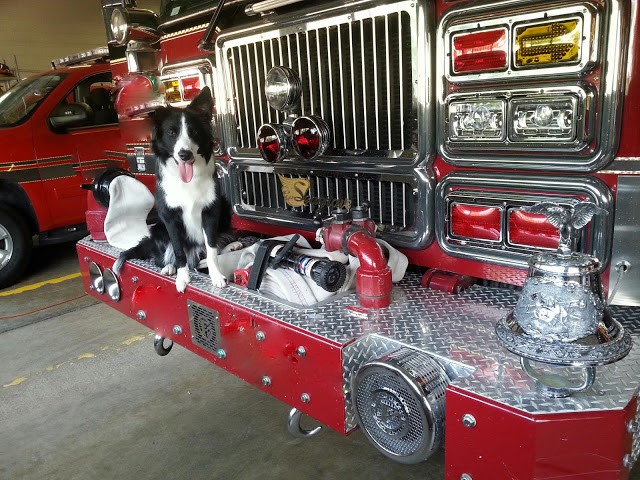
I don't bring my dog to the station very often. The vet clinic I take her to is right around the corner from one of the stations, so we occasionally stop by and take advantage of photo opportunities. She's very photogenic if you're holding one of her favorite toys. Border Collie concentration powers at work.

Come on, she's adorable, isn't she?

Fiona is making the engine look good. See? She can put both ears up--if she wants to.
Speaking of which, I have to get on to my next project. Finish one and another one turns up... Fiona wants to go outside. Again. 

Friday, May 15, 2015

A Day (Or Night) In the Life of a Volunteer Paramedic (Part 1): Typical Shift At The Rescue Squad

I was recently asked by a member of the public what a typical day is like for me. That is such a hard question to answer because each shift is so different. Being a bit of a smart aleck, I asked them "what day?" I work a rotating 24hrs on/72hrs off schedule with the private ambulance transport company. My volunteer paramedic schedule of 12hr shifts is set up around my work schedule. I prefer running as the Region A medic on Sunday and Monday nights. Sometimes I run Sunday days because I can take the chase car to church and respond from there. I also volunteer with the Fire Company which is separate from the Rescue Squad. Fire duty crew is a 12hr shift every 6th night. I work holidays, am out in all sorts of weather and I don't know what a "weekend" is anymore. And I haven't even started on the regular continuing education classes I have to take to keep my certifications current.

But let's give this a try. Let's assume that I'm on duty at the volunteer rescue squad as the regional medic. The shift begins at 6pm, but since everything in fire-rescue goes off 24hr clock time, it's actually 1800. I usually leave home at least an hour before the start of my shift to allow for travel time with rush hour. If it's one of the days when my roommate is working night shift and won't be home to take care of the pets I leave earlier so I can drop my dog Fiona off for a sleepover at a friend's house.

Well, she's already asleep in the car. Apparently, Fiona was more than ready for a sleepover while I'm on duty.
Once I get to the station, I change into my uniform if I'm not already wearing it and call the county dispatch center to place my unit in service. Then I do a quick duty check to make sure I have everything on the unit and change the battery in the portable radio.

One of the ALS Chase vehicles we used to run from the rescue squad station. Oh, and a helicopter.
Then it's time for dinner. You never know when you'll get a call, so food is always a high priority. Every time you sit down to eat, go to the restroom, start your workout, etc., you feel like you're tempting fate to give you a call. Most shifts, I end up coordinating dinner with the ambulance crew on duty. After dinner, I like to do training of some sort.

Extrication Training
Training can be pretty much anything. If you don't train your skills and knowledge gets rusty. You don't want to be trying to relearn that splinting procedure on a call. Training is important! Two of my favorite evening shift training options are doing area familiarization/driver training and practicing ALS/BLS skills. If you know the shortcuts, major streets and intersections--and even better the addresses, your response times are faster because you already know where you're going. Long summer evenings are perfect for this kind of area familiarization. Practicing skills such as intubations on the dummy, doing a drug bag check (and reviewing the indications, doses and contraindications for all the drugs in the bag), and teaching basic skills to new members are other good options. The more you know, the more you practice, the better you will be under stress in a critical incident. I also try to review at least one of the local protocols per shift. Knowing the protocols is very important, and there are always protocols you don't use very often.

Bunk room at the station. The night this photo was taken, I ran a lot of calls and consequently didn't spend much time in here.
After training, sometimes there is time to use the station gym, work on projects, and watch TV before bedtime. I usually pick a bunk room as soon as I'm done with my duty check and before dinner. And at any point in time, this routine can and will be interrupted by calls. In the area I cover, the average time it takes to run a call once you allow for response time to the scene, an on scene time of about 15-20 minutes, transport time and the return trip to the station (often via the scene to retrieve the chase vehicle) is about 2-2.5 hours. Critical patients require more documentation, so the report-writing time at the ED is longer.

People often ask how busy we are. The truthful answer is that it depends upon the day. Calls seem to come in waves. At one point in time, there will be 4 calls going on at once and I'll be on one and there will be units from 3 other stations on calls in my area. Other days I'll run nothing the entire shift. Some shifts I will run 6 calls and never really see the station.

Another question or rather statement I hear a lot, is "so you're an ambulance driver?" Well, technically, yes, I am. But I'm a whole lot more than an ambulance driver. I'm actually a paramedic. I've successfully completed about 2,000 hours of classroom and practical training, followed by about 8 months of field training before I was allowed to run calls on my own. So, "Yes, Ma'am. But I'm a little more than just an ambulance driver..."

Tuesday, May 12, 2015

Patio Garden Therapy

Late last summer, the garden and I moved…to a bigger patio about 8 miles down the road. There’s no space for an actual garden bed here and the management is really particular about what is on your patio. So I’m making do with a few more pots. I also had to get a storage bench to hold my gardening stuff. Not that there’s anything wrong with more pots, beautiful flowers, or a nice reading spot in the middle of them…

Rocking chair and patio tomatoes...and the lovely Fiona with her frisbee.
Back in March, my “black cloud” showed up again, and I ran a series of tough calls. It didn’t seem to matter if I was riding backwards in the bucket seat on the engine, covering as the Region A medic, helping a friend with driver training in preparation for EVOC or having another insanely busy day working at the ambulance transport company. It all began with a code that went out a couple miles from the station Wednesday night.

Every new medic needs at least one confidence-building critical call, where given all the variables everything goes pretty much like clockwork. I’d come down to the station to take one of the new members out in the second out (unstaffed) ambulance for pre-EVOC driver training. Just as we were about to head out, the station tones dropped for a cardiac arrest and an EMT/driver walked in and asked if I wanted to take the call. A quick check showed that we were much closer to the scene than either of the two medics initially dispatched and the first out unit wasn’t at the station. So I grabbed my drug keys, we squirreled it and arrived on scene just after the engine and before all the other EMS units. I grabbed the drug bag, walked in and handed out work assignments to the crew to facilitate the “pit crew method” I heard about at the EMS Today Conference earlier this year. From there it went like clockwork. The patient started in asystole and when we reached the ED 10mg of Epi and 50mEQ Sodium Bicarb later the patient was still in asystole and the doc called the code. Unfortunately, asystole (aka flatline or no heart rhythm at all) is the stablest rhythm of them all.

The next day I was at work, and it was one of those really busy days. One of my patients that shift was a tiny premature baby who had developed necrotizing enterocolitis. Necrotizing enterocolitis is the death of tissue in the intestine and occurs most often in premature or sick babies with a 25% mortality rate according to the National Institute of Health.[i] I checked with the doc in the Peds ED the next week and he confirmed that thankfully this little one was treated in time and survived.

A dressed up patio storage bench turns this corner of the patio into an inviting place to relax outside.
Mama ducky is admiring that orange Gerbera daisy too. 
The next night, after a busy day acquiring the patio storage bench, I had fire duty. Riding backwards on the engine can be fun and a nice break from bossing a medic unit... until you get dispatched on that 2:50am stabbing three doors down from the firehouse, are the only medic on the engine and are first on scene after the police. We did everything we could. This patient's wounds were too severe and he practically bled out in front of us and in the end did not survive. The calls where a patient starts out talking to you and ends up dead are the worst. This one was particularly difficult due to the circumstances.

Needing some version of therapy after those calls, and now that spring had arrived, I started working on the garden again. I still have a few pots I haven’t planted yet. Between turning an old bookshelf into a potting bench and acquiring a storage bench/seat per request from the management company, the patio has become a lovely place to read and work.

New job for an old bookshelf: potting shelf.
The rest of the garden is still in the works, but I have squash, beans, cucumbers and a variety of herbs and flowers growing.

Planter of Basil varieties and the lonely Zucchini plant.

When you spend a significant portion of your time caring for ill, injured and dying people, it's nice to be able to come home and care for something healthy and alive.
Green Beans.
Cucumbers and trellis.

I like to daydream about God being the supreme gardener. He has more plant varieties than I could ever dream of...and He's got the whole universe to grow them in. But you can also think of gardening as an analogy for life. Any gardener knows that caring for a garden requires weeding, thinning, pruning and re-potting. God does the same for our lives. We may not know the master plan for the garden, but He does. And in the end, He works everything together for our good and His glory-- even though we may not see it at the time. In the end, God is the one who gives and takes life. I've gotten to see a decent share of both recently. It's a good reminder that it is a privilege to be alive. Use your time wisely and don't take it for granted. We never know when our time on earth is up. Don't waste your life.

Citronella, Violas and Oxalis (shamrocks) decorating a corner of the patio.
For me, that means doing my job at work or as a volunteer to the best of my ability and then coming home and taking care of my garden... and spending time playing with and training my dog Fiona.

Fiona at 9 months
Besides, who knew Border Collies loved to swim?

Yep...she's out there swimming after a stick.

[i] http://www.nlm.nih.gov/medlineplus/ency/article/001148.htm

Thursday, April 30, 2015

Taking A Break From The Garden: Puppy Time!

Last August I took a break from gardening for a little while after moving. Why? Because I acquired a small fuzzy ball of trouble, mayhem, energy, messes, fun and total cuteness: also known as my Border Collie puppy Fiona Grace or "Fi" (pronounced "fee") for short.

NOTICE: This is your warning that there will be a LOT of puppy pictures in this post.

Last July, I stopped by southern Virginia on my way to North Carolina for some R&R after paramedic class to meet the litter of puppies and decided I wanted the only girl in the litter of four. She was about the size of a Guinea Pig and really cuddly. I spent the next four hours I was driving talking to my car about puppy names. Half the list I'd picked out earlier just didn't seem to fit this little girl's temperament. Finally settled on calling the little princess Fiona because not only is it a traditional Border Collie Name, she was spunky and stood up to all three of her bigger brothers kind of like the character in the TV show Burn Notice. And before you ask, I was completely unaware of the movie Shrek. Never seen it.

Hello world, meet Fiona!
My friend (and fellow volunteer paramedic) ended up getting one of her brothers, so we carpooled down to pick up the puppies in August and my roommate came along for the ride.

Fiona and her brother decided to cuddle with my roommate on the way home.
The next few weeks were a blur. Figuring out puppy-sitting arrangements on the days my roommate and I were both working, vet appointments, starting initial training, socializing her and getting her used to strange loud noises and large objects. With such a busy schedule, she took frequent naps to keep up her incessant energy.

So tired and so small!
She loved to chew. One of her favorite toys was (and still is) this Kong binkie. Especially if it's filled with chunky peanut butter.

Two Months old with Binkie
Four months and the ever-present binkie.
Six Months with Binkie. She's lost the puppy fuzz now.
Taught her to enjoy strange things--like drinking out of a syringe, and normal things like sit, down & stay. Oh, and look at me to so I can take yet another picture with you looking this time.

Two months and drinking water out of a syringe during a visit to the Rescue Squad station.
Three months and I FINALLY have her full attention for a few seconds.
I had her attention in the last picture because I was holding her new favorite toy: a Frisbee. We've gone through about five of these now. She's truly obsessed with the game. She's eight months in this picture.
We've been hiking, pumpkin picking, and visited the fire station I volunteer at. The bells going off or the tones dropping don't even bother her. She's working on getting comfortable around crowds since she's a little shy with new people.

Hiking to Bear's Den at 4 months.

Pumpkin picking at 4 months
Posing on the front of the engine during a visit to the fire station. Almost five months old.
Posing in one of the chase vehicles for National Puppy Day. Seven Months old.
She's now reached the fine age of 10 months. She's all of about 35 lbs, fast, smart, and totally obsessed with balls, frisbees, and cats. Good old Border Collie instinct kicking in because she wants to round up all kinds of things. Chickens, cats, me... We're getting pretty good at the basic obedience commands. She's a good traveler and I take her everywhere I possibly can. So much fun now that she's patient enough to focus and obey commands!

All a girl needs when going hiking: backpack and faithful canine companion. Fiona is nine months in this photo taken at Bear's Den. 
As you can see, I've had my hands full with this one. She's finally reached an age where her body has grown enough that I can start agility and sheep herding training with her. Going to try obedience competition first though. And then maybe we should try something that involves swimming...

Fiona at nine months. She's on a nice "down-stay" in the middle of a patch of bluebells we found next to the Bear's Den lodge on the Appalachian Trail. Isn't she gorgeous?
At ten months, she's staying cool while playing fetch with a stick in a lake and giving her best "drowned rat" impression.  
Fun and exciting times coming up this summer! Her new thing is to have me throw the frisbee from the patio and leap over my pots to go fetch it. As long as she doesn't tip over all my plants in her pursuit of the frisbee, ball and cat, we'll be fine.

Until next time then...

Sunday, July 20, 2014

Creating a Fairy Garden and Picking a Puppy Name

During one of my shifts as the Region A medic a few weeks ago, I stopped by the farmer's market in Purcellville and talked with a couple of the ladies from the Loudoun County Master Gardener's. They recommended a visit to Abernathy & Spencer Nursery off Lincoln Rd. in Purcellville, VA, which is well worth a visit if you love plants. In one of the greenhouses there are a couple examples of miniature gardens. I've always been fascinated by tiny things, and when I was in high school, my brothers and I decided that it would be fun to build an outdoor model railroad and landscape it with small-scale plants. We never did get out of the planning stages.

I did a little research, and found that these kinds of miniature gardens are frequently called "Fairy Gardens" and I decided to make one. My gardening budget is small, and the hardest part of this whole project was finding a suitable container. It needed to be at least 6in. deep and have space for about 10 plants. And it couldn't be very expensive. I visited several thrift shops and came home with a pair of odd-shaped res plastic serving bowls and assorted small dishes and objects that would serve as furniture and tools for the little fairy figure to use in her garden. 

Plants, containers and decorations used in Fairy Garden project


The assembly process took about an hour, more or less. The hard part was figuring out how to arrange the plants so you could see them all and no two of the same kind were precisely next to each other. I think the end result is delightful.

The entire Fairy Garden

Detail of the pond and the fairy herself


The Fairy's house and front yard


In other news, now that I'm finished with Paramedic class (Yay!), I've decided it's time to get a dog. I've always wanted a Border Collie to do obedience competitions, go running and hiking with and play frisbee. I've looked into rescuing one, but given the existing crew of two Welsh Corgis, a Welsh Corgi mix and a large ginger and white cat that my roommates own, it looks like getting a puppy might be the best option to not completely overturn the existing pet social dynamics. So after doing a lot of research, I decided that my best bet is probably to get a female, and while puppies are and insane amount of work, I can start from scratch and train it the way I want. Obviously, digging in my garden, eating my flowers and jumping on the furniture will be taboo. So the aunt of a girl I know from the rescue squad breeds breeds her working Border Collies and competes in dog sports with them. One of her dogs had a litter of puppies the same day I took the National Registry Paramedic written--three boys and a girl. I have first pick of the litter, and I'm planning on adopting the girl.
Further research into traditional Border Collie names has me wondering what to name the little one. Traditional Border Collie names are usually one syllable, often after a natural geographical feature, or the common name of a farm worker. It also needs to be something I'm not going to be embarrassed to say in front of people, and easy to yell across a field. So when we're hiking the Appalachian Trail together and she's running up the trail ahead of me and I need her to come back... Her kennel name is "Daisy" right now. So even though she's going to be a ton of extra work and trouble, calling her "Trouble" is certainly out. I found this nice list of traditional names and decided to pick a few to start with:(http://www.bordercolliemuseum.org/BCNames/BC_Names.html). This is lots of fun...
I've decided to wait until I meet her and get to know her temperament before actually naming her. Still exciting!

Tuesday, July 1, 2014

Elfin Thyme, Shiny Objects, and Helicopters

Small things, shiny objects and flying things all tend to fascinate people. Who wouldn't look at a very small plant and smile, wonder how the Hope Diamond could be real and take every opportunity to watch a helicopter? I do.

Speaking of shiny objects, I had the opportunity to visit the gems and minerals exhibit at the Smithsonian Museum of Natural History last Wednesday. The photo below is of the Hope Diamond. It's about the size of a walnut, and if you view it from the right angle it's a spectacular blue, from other angles it usually looks charcoal gray. And it's apparently a priceless bit of rock. Isn't is wonderful that anyone who visits the museum can go see this rare bit of God's beautiful creation for free?

The Hope Diamond on display at the Smithsonian Museum of Natural History.
While I was there, I also visited the butterfly pavilion on the 2nd floor. You do have to pay admission, but I thought it was worth it. All those beautiful butterflies and moths from all around the world. Wow! I'm still in awe of the wonders of creation and the God who made them all. I think I need to add a butterfly bush to my plant collection, too bad I didn't think of that when I stopped by Southern States my last Region A medic shift.

In my wanderings while playing Region A medic last Saturday afternoon, I stopped by the farmers market in Purcellville to pick up fresh local vegetables. One of the booths at the market was Loudoun County Master Gardener's. The ladies and I ended up talking for a good 15 minutes about the fun and challenges of growing things in Loudoun. I've been having trouble getting rid of mealybugs on my plants, so we naturally got started talking about natural pest deterrents. The best solution to my problem seems to be regular applications of insecticidal soap. But did you know that planting certain things together can help with other pests?

For example, planting marigolds tends to repel rabbits. And nematodes. And marigolds are pretty. I need to plant some. Growing citronella helps to reduce the mosquito population on the patio. One of the plants I picked up and planted over the weekend is a beautiful little citronella plant. 
Citronella plant in the foreground.

While I was in the process of planting stuff, three little praying mantises turned up. They were about the diameter of a 20ga IV catheter and maybe 1in. long. I hope they stay and eat all the bad bugs.


I must also be obsessed with helicopters. I really enjoy calls where we get to fly patients only because I get to watch the helicopter land and take off. Here's this post's helicopter picture.


This the only double flyout I have run to date. Aircare 1 and Fairfax County PD transported the two patients from a rollover accident in May.


Until next time...

Friday, June 20, 2014

Allergic reactions...that turn into Codes.

You can call me a coward, but there are some situations I hope I never have to face as your friendly neighborhood paramedic. I'll train for them so I'll be prepared if they come, but I pray they don't happen when I'm on duty. Firefighters, EMS personnel and law enforcement officers come across extremely sad and often gruesome situations as a regular part of the job. So often, you show up and even with all of your training and expertise there are situations where you don't know what to do and sometimes there is absolutely nothing you can do. These kinds of situations take an emotional toll on those entrusted with handling them. 
Wildflowers

Running cardiac arrests is a fact of life as an EMS provider. We call them codes. Usually, if they are dead when we get there, they tend to stay dead. We do our best, but few un-witnessed codes actually end in a "save." In my five years with the Rescue Squad, I've been on at least 6 codes, not counting the one described below. Only one of them made it to the ER alive, but he died in the ICU a couple days later. The one that died in front of us...well, he had a massive Pulmonary Embolism (blood clot in the lungs) and never had a chance. I've never truly had a cardiac arrest "save" who made it home from the hospital...until this week.

This past week, I was on duty as the regional medic in the west end of Loudoun County--Region A. Think of this as being the EMS equivalent of a K-9 unit. In the 1/4 of the county that I cover, there are a lot of ambulances with EMTs, but I'm the only medic--or ALS provider. If I need a medic for backup, they are about 15 minutes away. To continue the story...I'd gone out to dinner with the ambulance crew from my station. It was a hot, muggy day and a large storm center had just hit the town we were in. Thunder, lightning (lots of ground strikes) and a huge downpour. 

In the middle of this, our food had just arrived when the tones were dropped at 19:28 for a 15 year-old-female having and allergic reaction w/trouble breathing at another restaurant in town about 1/2 mile away. I had a bad feeling about this one, and beat the ambulance to the scene by about a minute. As I pulled into the parking lot, the mom came running out into the storm to tell me the girl was barely breathing. I unlocked the drug cabinet on my chase vehicle, grabbed my drug bag and went into the restaurant. The girl was lying there on the floor next to the bench near the entrance breathing like a fish out of water. I didn't have enough time to give her anything before she stopped breathing. Praise God the ambulance crew came in just then, because respiratory arrest very quickly turned into cardiac arrest. We did CPR for about 2.5 minutes before we got her back, and went through the allergic reaction protocol. 

Another medic just happened to be at the restaurant and jumped in to help. I was incredibly glad to have him there helping because the next closest medic was coming from 12 miles away and I needed help yesterday. We got her to the hospital alive (she was complaining that her chest was sore), although three minutes out from the hospital the medications wore off and in less than a minute she breathing like a fish out of water again. We were assisting her breathing with a BVM again by the time we arrived. She was quickly sedated, intubated and placed on an Epinephrine drip by the ER doc before being transferred to a children's hospital. She was extubated about 11:30 that night, was discharged from the hospital later the next day. For me, this allergic reaction code was a big deal. Not only was it the first severe allergic reaction I have run since getting released as a medic, not to mention the first code, but the patient was the same age as my youngest sister. Very scary. All things considered, the call went well. Praise God this one ended so well!

I've found several ways to de-stress after a significant call like this one. Usually after a call like this, I end up reviewing and criticizing the actions performed on scene to see what can be done better the next time. But when that's over, it's time to deal with the stress. Some form of exercise usually works, running, swimming, hiking, taking a ballet class. I also like to make a trip to the library for a new book and will spend hours working on my garden while listening to music. This time around, I picked up a book on the science behind the Sherlock Holmes stories. As for music, I'm currently into a CD of harp concertos I picked up from a thrift store and the soundtrack for Captain America: The Winter Soldier that I found on YouTube. The garden looks lovely now after a bit of cleaning up.